
The letters do not matter
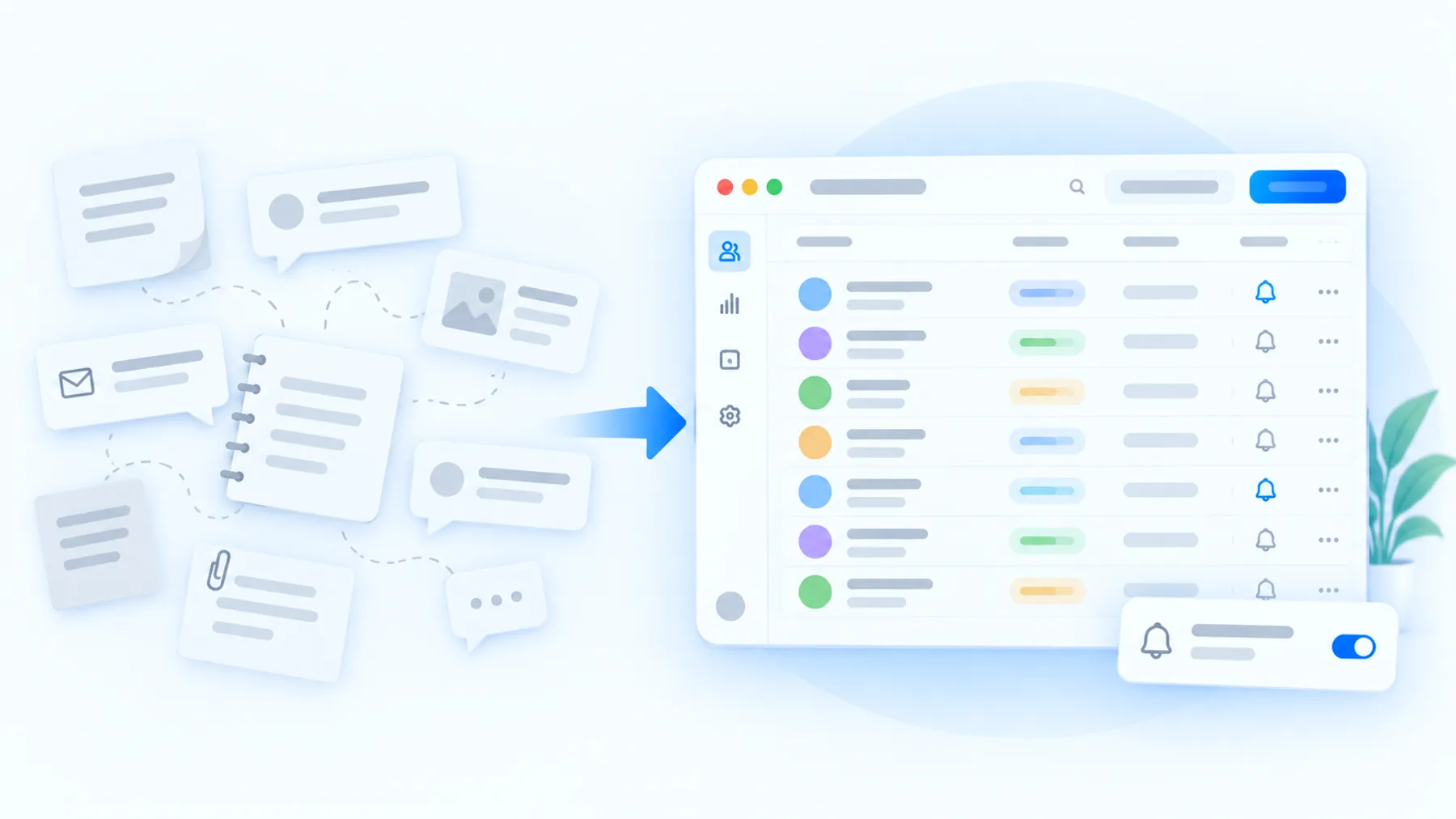
CRM stands for customer relationship management, which tells you almost nothing. In practice a CRM is one list of everyone who has ever contacted your business, with what happened to each of them attached.
That is the whole idea. Everything else is a consequence of having that list in one place instead of spread across a phone, a register, three chat threads and one person's memory.
The four problems it removes
1. The enquiry nobody followed up
This is the expensive one. A customer calls, asks about a price, and says they will think about it. Somebody writes the number on a pad. A week passes. The pad has moved. Nobody calls back, and the business never finds out that it lost the order, because a sale that never happened does not show up anywhere.
In a CRM, that call becomes a record with an owner and a date for the next contact. If the follow-up does not happen, that is visible as an overdue item rather than invisible as a forgotten one.
2. Two people calling the same customer
The mirror image of the first problem, and almost as damaging. The customer gets called twice about the same thing by two people who each ask the same questions. It reads as disorganised, which is the opposite of what you want when someone is deciding whether to trust you with money.
Assigning an owner to each enquiry costs nothing and removes this entirely.
3. History that walks out of the door
When the person who handles an account is on leave, the account is effectively on leave too. Nobody else knows what was discussed, what was quoted or what was promised. When that person leaves the company permanently, the relationship often leaves with them.
If the conversation is recorded against the customer rather than held in a person's head, anyone can pick it up. This matters more as a business grows past the point where the owner personally remembers every customer.
4. Not knowing where business comes from
Ask most business owners which of their marketing efforts produces customers, and you will get an honest guess. A CRM that records where each enquiry came from turns that guess into a number, which then tells you where the next rupee of marketing should go.
A quick test
Pick a customer who bought from you four months ago. How long does it take you to find out who first spoke to them, what they were quoted, and what they actually paid? If the answer is more than a minute, or involves asking somebody, that is the gap a CRM fills.
What it does not do
It is worth being clear about this, because CRM projects fail more often from expectation than from software.
- It will not decide your process. If nobody currently agrees who owns a follow-up, the software will not settle that argument. That conversation has to happen first, and it is usually a short one.
- It will not fill itself in. If your team does not record calls, you will have an empty system. The fix is making entry fast enough that it is easier to do than to skip, which is a design question as much as a discipline one.
- It will not sell anything. It removes the clerical reasons that sales do not happen. The selling is still yours.
Are you ready for one?
There is a reasonably reliable signal. If you can hold every open enquiry in your head at once, you do not need a CRM yet. The moment you cannot, and you start relying on notes to remember who is waiting on you, you have already built a worse version of one.
Most businesses cross that line somewhere between two and five people handling customers, or when enquiries pass roughly twenty a week. Before that, a notebook genuinely is fine. After it, the notebook is quietly costing you orders.
Starting small
You do not need to move everything at once. The usual sequence that works is:
- Get every open enquiry into one list, however rough.
- Give each one an owner and a date for the next contact.
- Only then worry about history, reporting and campaign lists.
Steps one and two produce most of the benefit. Everything after that is refinement, and it is much easier to do once the habit of recording exists.
If you want to see this against your own business
Our team will go through how enquiries reach you today and show you what the same week looks like once they are tracked. Get a proposal, or read more about our CRM.