
Start with the question your customer is actually asking
Someone two kilometres away needs what you sell. They pick up their phone and search. The entire job of your digital presence is to be the answer to that search, and then to be convincing enough that they call.
Almost everything else is secondary. Keeping that single scenario in mind is what stops businesses spending on things that look modern but produce nothing.
The order that works
1. A business profile on the map (cheapest, highest return)
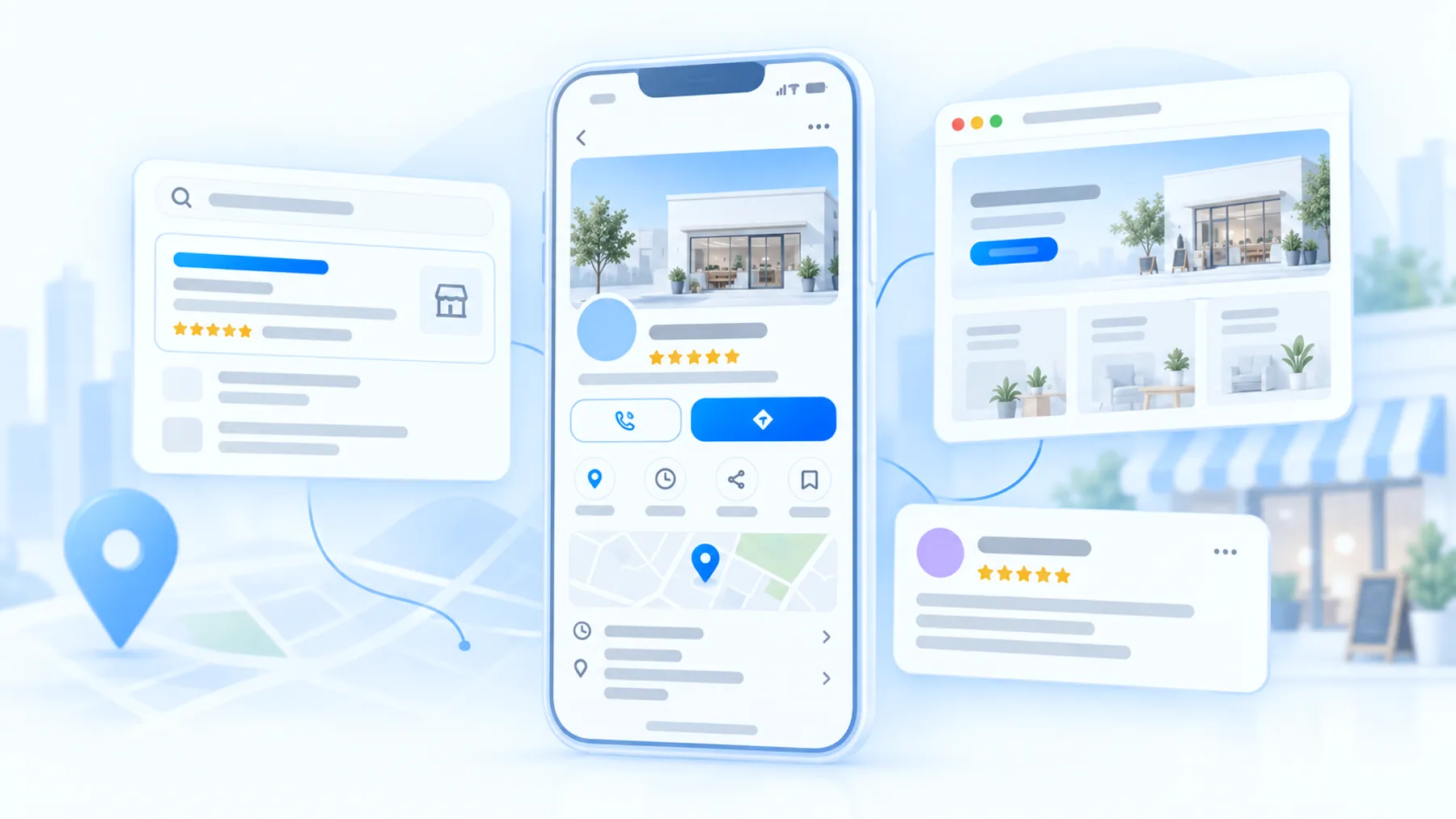
For a local business, this outranks everything. A complete Google Business Profile with correct timings, a phone number that works, a current address and real photographs puts you in front of people searching nearby, and it costs nothing but attention.
The two things most businesses get wrong here are leaving it half-filled, and never adding photographs. A listing with twelve recent photos looks like a going concern. One with none looks closed.
2. Reviews, asked for properly
Also free. The businesses that have reviews are almost always the ones that ask for them, not the ones that happen to be better. Ask at the moment a customer is visibly pleased, make it easy with a link, and never pay for them. Fake reviews are obvious to customers and increasingly obvious to the platforms.
3. A website that answers the obvious questions
This is where money starts being spent, and where it is easiest to waste. A local business website needs to load quickly on a phone with an ordinary connection, and answer: what you sell, where you are, when you are open, what it roughly costs, and how to contact you. That is it.
An elaborate site that takes eight seconds to load will lose to a plain one that takes two. If you are choosing between a bigger design and a faster site, choose the faster site.
A test worth running
Open your own website on mobile data, not office wifi. Count the seconds until you can read something useful. If it is more than three, that is the first thing to fix, ahead of anything else on this list.
4. Search optimisation for the terms people actually type
Not the industry language you use internally. Customers search for the problem in plain words, often with a place name attached. Getting the right phrases onto the right pages is unglamorous work, and it is what moves a site up the results.
Treat anyone guaranteeing a specific ranking position with suspicion. Nobody can promise that, because nobody controls the ranking.
5. Social media, only where your customers are
Being on every platform is worse than being active on one. Pick the platform your customers actually use, post at a rhythm you can sustain for a year, and reply to people who comment. A page that posted energetically for one month and then went quiet is a negative signal, not a neutral one.
6. Paid advertising, once the rest is in place
Advertising is the accelerator, not the engine. It sends people to your website and your profile, so it magnifies whatever is already there. If those are not convincing, advertising just buys you more people leaving.
Start small, target tightly by area, and insist on knowing the cost of an actual enquiry rather than the cost of a click. If nobody can tell you that number, that is the problem to solve first.
What to skip, at least for now
- An app, in most cases. Customers rarely install an app for a business they buy from occasionally. A fast website usually does the job. There are exceptions, mostly where people order repeatedly.
- A blog nobody will write. Useful when maintained, actively harmful when the last post is three years old.
- A chatbot on a small site. If the same person answers the phone, they can answer a message. A bot that cannot help is worse than no bot.
Connecting it back to the business
One thing worth planning early: what happens to an enquiry after it arrives. A website form that lands in a mailbox nobody checks is not better than no form. Enquiries from the website, the map listing, the phone and social should end up in the same place as everything else, with an owner and a follow-up date.
This is the point where digital presence and the way the business runs internally stop being separate subjects. Getting attention is only worth paying for if the business is set up to act on it.
Working out where to start
We will look at what you have online today and tell you which of these steps would make the most difference first. Get a proposal, or see the digital services we offer.